Customising Python autocompletions using Jet ✈️
Jet is a recently released Jupyter kernel supervisor for the terminal. This post shows one of the many cool things it can do.
Python language servers like pyright, ty, pyrefly etc provide completions using static code analysis. This means that they can't surface information from your Python runtime; they only show information which can be readily inferred from the codebase.
For example:
import pandas as pd
my_df = pd.read_csv("my_df.csv")
my_df["│
# Cursor hereIt would be lovely to get column name autocompletion here, but since the language server can't look into the contents of my_df.csv, in this case it can't give us anything useful.
Note: if you often work with unfamiliar datasets, column completions are really useful!
If you already have my_df available in a Python runtime though, why shouldn't you be able to simply pass my_df.columns over to your completion engine?

Why not indeed - IPython provides a nice API to do exactly this! And, if you're using ipykernel via Jet, you can pass the resulting completions over to any editor which speaks the language server protocol.
Basic completions for pyspark DataFrames
You can define custom completions for any class using the IPython matcher API. IPython is actually smart enough to provide simple completions for pandas out of the box, but currently has no special handling for Pyspark.
We can achieve a lot with only a couple of lines of code:
from pyspark.sql.dataframe import DataFrame

DataFrame._ipython_key_completions_ = lambda self: list(self.columns)
Where should I put this code?
One nice option is to use your user-specific IPython config. Eagerly importing pyspark is probably not a good idea though. Instead, you can use IPython to check whether pyspark is loaded after each execution, and only install the completer if it is:
# $HOME/.ipython/profile_default/startup/pyspark-completions.py
import sys

from IPython.core.completer import (
    SimpleCompletion,
    context_matcher,
)

_ip = get_ipython()


def _install_key_completions(_):
    # Classic pyspark (e.g. databricks-connect 15.x) exposes DataFrame at
    # pyspark.sql.dataframe; Spark Connect (databricks-connect 16+) returns a
    # separate pyspark.sql.connect.dataframe.DataFrame with no shared base, so
    # check whichever modules are loaded.
    for name in ("pyspark.sql.dataframe", "pyspark.sql.connect.dataframe"):
        if (m := sys.modules.get(name)) is not None:
            m.DataFrame._ipython_key_completions_ = lambda self: list(self.columns)


_ip.events.register("post_run_cell", _install_key_completions)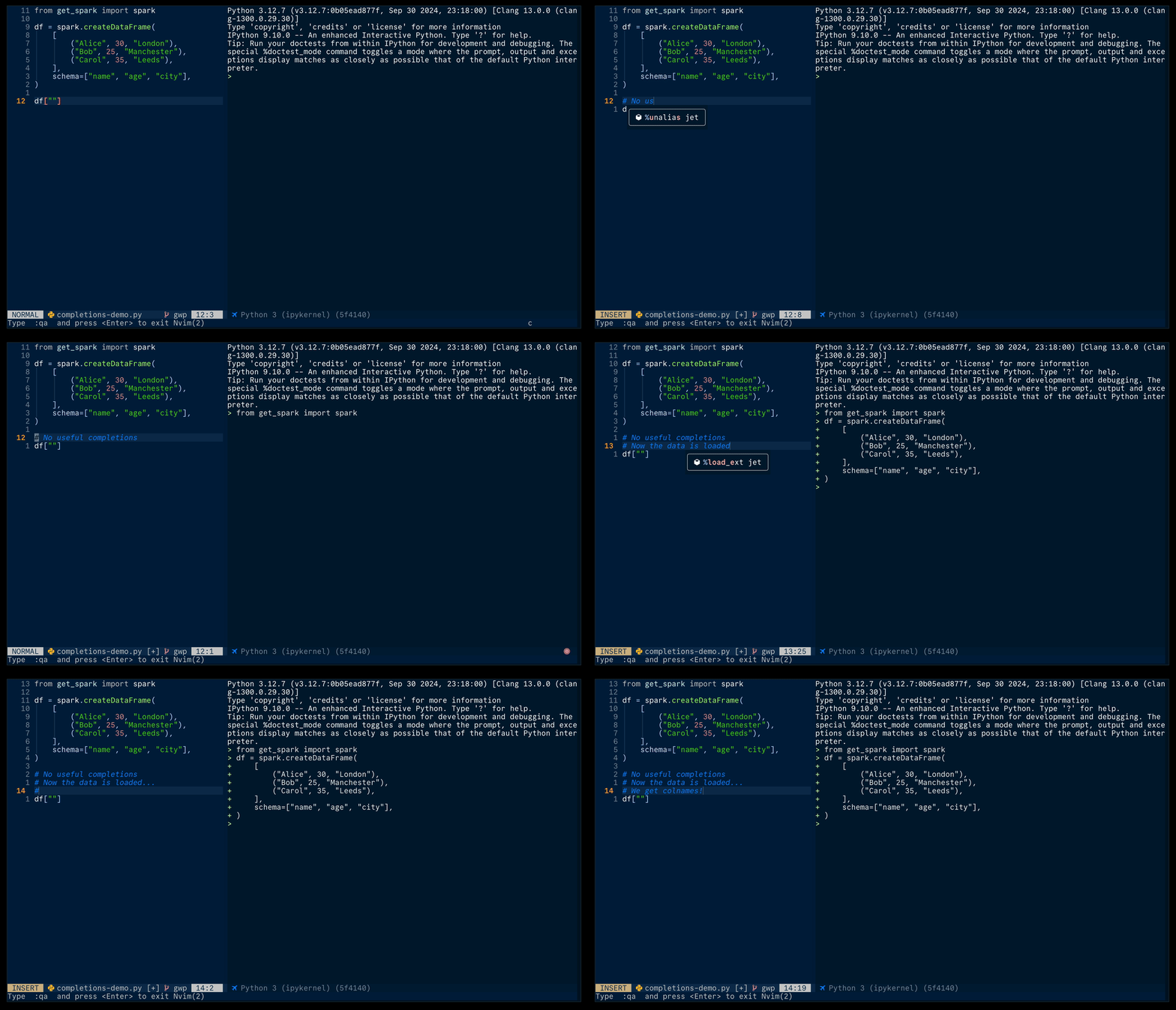
Note 1: for the above gif I put the code snippet in my user-level IPython config, so it loads automatically with each session.
Note 2: to get this in Neovim you should use jet.nvim, and maybe jet.ipy if you want more Python features.
Triggering completions in DataFrame method chains
In practice, pyspark code tends to look like this:
processed = (
    my_df.filter(F.isnotnull("id"))
    .select("foo", "bar")
    .withColumn("baz", F.coalesce("foo", "bar"))
)
Each of the strings in the above code refer to column names, and they're all places where we can trigger completions. The basic approach is:
- From the cursor position, ascend the syntax tree to determine
- If the cursor is currently in a string
- If the cursor is currently in a
DataFramemethod which operates on columns, e.g.select(),filter(), etc - The code for the 'root' node, e.g.
"my_df"in the above snippet
- Send the columns from the root
DataFrameto the completion provider
The following code is what I'm using for this right now, although readers may want to also check my actual config, as this will likely evolve in the future.
import ast
import sys

from IPython.core.completer import (
    SimpleCompletion,
    context_matcher,
)

_ip = get_ipython()


_COL_METHODS = frozenset(
    {
        "agg",
        "coalesce",
        "drop",
        "filter",
        "groupBy",
        "groupby",
        "isnotnull",
        "isnull",
        "join",
        "orderBy",
        "partitionBy",
        "select",
        "sort",
        "where",
        "withColumn",
        "withColumnRenamed",
        "withColumnsRenamed",
    }
)

# Suffixes to try appending to make an incomplete snippet parseable — closes an
# unterminated string plus up to 3 levels of nested calls.
_CLOSINGS = [q + ")" * n for n in range(4) for q in ('"', "'")]


@context_matcher()
def _df_col_matcher(context):
    df_classes = tuple(
        m.DataFrame
        for name in ("pyspark.sql.dataframe", "pyspark.sql.connect.dataframe")
        if (m := sys.modules.get(name)) is not None
    )
    if not df_classes:
        return {"completions": []}

    # cursor_position is line-relative. Rebuild the snippet up to the cursor and
    # note the cursor's (lineno, col) in AST coordinates (1-indexed line).
    lines = context.full_text.split("\n")
    current_line = lines[context.cursor_line]
    col = min(context.cursor_position, len(current_line))
    snippet = "\n".join(lines[: context.cursor_line] + [current_line[:col]])
    cursor = (context.cursor_line + 1, col)
    prefix = context.token.lstrip("\"'")

    tree = None
    for closing in _CLOSINGS:
        try:
            tree = ast.parse(snippet + closing)
            break
        except SyntaxError:
            continue
    if tree is None:
        return {"completions": []}

    def has_cursor(node):
        return (
            (node.lineno, node.col_offset)
            <= cursor
            <= (node.end_lineno, node.end_col_offset)
        )

    # Innermost call first; walk outward until we find a DataFrame method.
    calls = sorted(
        (n for n in ast.walk(tree) if isinstance(n, ast.Call) and has_cursor(n)),
        key=lambda n: (n.lineno, n.col_offset),
        reverse=True,
    )

    for call in calls:
        func = call.func
        if not isinstance(func, ast.Attribute) or func.attr not in _COL_METHODS:
            continue
        if not isinstance(func.value, ast.Name):
            continue
        df = _ip.user_ns.get(func.value.id)
        if not isinstance(df, df_classes):
            continue
        return {
            "completions": [
                SimpleCompletion(text=c, type="value")
                for c in df.columns
                if c.startswith(prefix)
            ],
            "suppress": True,
        }

    return {"completions": []}


_ip.Completer.custom_matchers.append(_df_col_matcher)